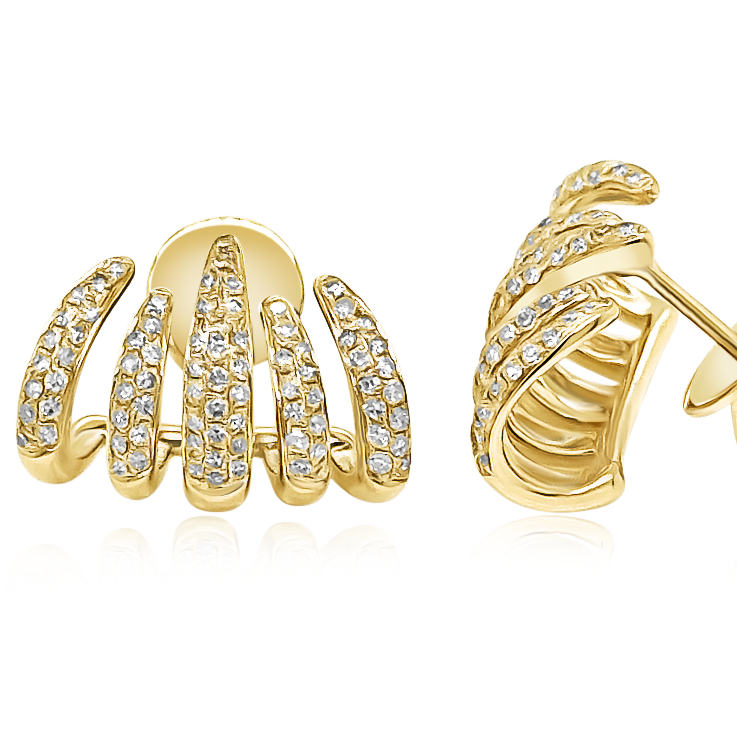
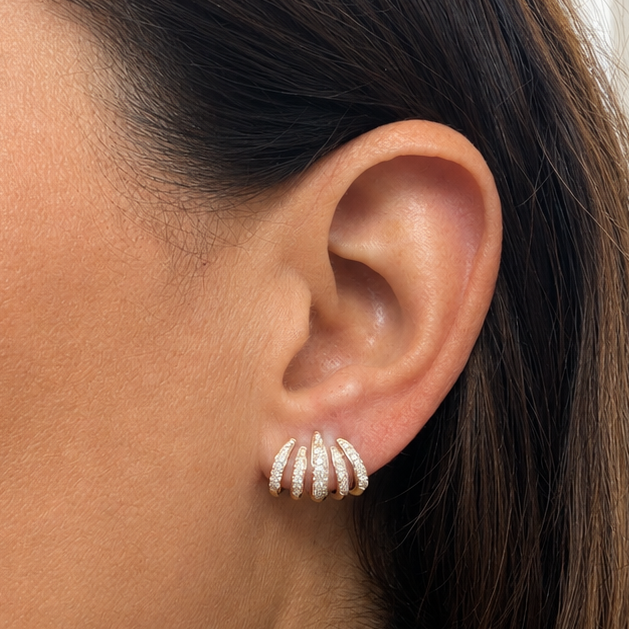
0.55 ctw Pavé Diamond Claw Lobe Stud Earrings – 14k Yellow Gold
- Regular price
-
$1,855.00 - Regular price
-
- Sale price
-
$1,855.00
14k yellow gold. 162 round diamonds, 0.55 ctw. Sculptural claw design.
One hundred and sixty-two diamonds across 0.55 carats. Each stone averages about a third of a point — near a millimeter.
The difficulty here is not the count. It is the surface. These are not set into a flat plane; the gold curves and layers in overlapping claw forms, and pavé on a compound curve is a fundamentally harder problem than pavé on a panel. Every seat has to be cut at its own angle so the stone’s table sits perpendicular to the surface at that exact point. Get one wrong and it tilts, catching light out of step with its neighbors. Your eye finds it instantly even if you cannot say why.
Done correctly, which it is here, the effect is that light travels across the piece as you move rather than flashing all at once. That continuous movement is what separates sculptural pavé from a cluster.
Yellow gold underneath does something specific for stones this small. At a millimeter, a diamond returns very little white light on its own — there simply is not enough depth for much internal reflection. What you actually see is warm metal glowing up through the stones. In white gold, work at this scale can read grey. In yellow, it reads golden and lit.
They sit flat against the lobe, so all of that presence arrives with no weight and no drag.
Couldn't load pickup availability